April 11, 2011
Welcome!
Posted by jterhune under Uncategorized | Tags: Friends of the Lower Calaveras River, Welcome |[5] Comments
November 4, 2016
October 27, 2016
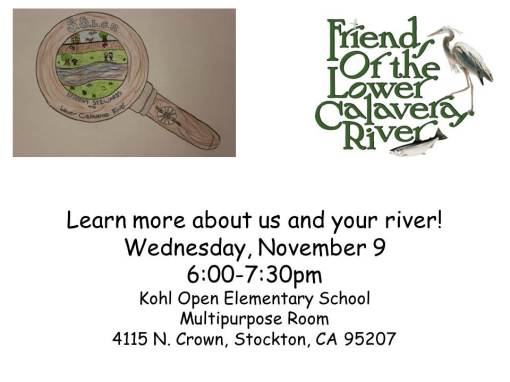
Join us rain or shine!
Posted by sshermanflcr under Education, Native Grass RestorationLeave a Comment
Kohl Elementary School’s Student Stewards of the Lower Calaveras are teaming up with FLCR to treat the community to music, crafts, science demonstrations, history, and nature appreciation.
“Home base” is the University of the Pacific DeRosa University Center 2nd story deck, overlooking the river we love. Parking is available at either end of the footbridge.
Sunday, October 30, 11am – 1pm
March 30, 2015
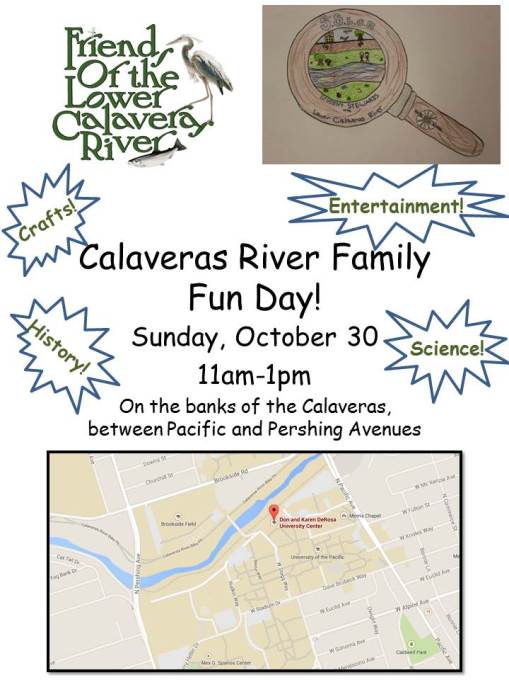
2015 State of Our Rivers Symposium!
Posted by jterhune under Education | Tags: drought, river symposium, water storage |Leave a Comment
|
|
|||||

|
|||||
|
FREE ADMISSION!
BREAKFAST, LUNCH, AND REFRESHMENTS WILL BE PROVIDED!
PARKING AVAILABLE AT THE CENTRAL PARKING GARAGE
September 2, 2014
California Drought Threatens Nation’s Most Productive Farming Valley
Posted by jterhune under UncategorizedLeave a Comment
In the rich farmland of the San Joaquin Valley it’s summertime — peak growing season for many crops. But every sunbaked, scorching day brings another test of water reserves in a region running on empty.
The dearth of irrigation water from rivers or reservoirs has forced growers in the valley 80 miles north of Los Angeles to rely almost entirely on water pumped from wells.
“I’m worried from a couple of standpoints,” said grower Stuart Woolf, as he stood in a field of tomatoes at harvest time. “One, I’m worried that we just flat run out of groundwater.”
Some growers have already taken draconian steps to deal with the reality that they don’t have enough water for all their crops. Near Fresno, Shawn Stevenson bulldozed a third of his orange grove.
July 23, 2014
Calaveras River featured in feds’ ‘recovery plan’
Posted by jterhune under Endangered Species Act | Tags: Calaveras River, Fall Run Chinook Salmon, HCP, NMFS, NOAA, steehhead |Leave a Comment
By: Alex Breitler, Record
Often mistaken for a drainage ditch, Stockton’s humble Calaveras River has potential to aid in the recovery of threatened Central Valley steelhead, a federal fish agency said Tuesday.
Measures to help Calaveras steelhead are part of a much broader “recovery plan” released Tuesday by the National Marine Fisheries Service. The document was described as a “road map” to restore not only steelhead but also imperiled salmon up and down the Valley.
Click here to read more at Recordnet.com
March 11, 2014
In severe drought plan, California salmon may be moved by truck
Posted by jterhune under salmon, Water is for Fighting Over | Tags: CA, drought, salmon |Leave a Comment
Starting next month, millions of young California salmon could be migrating to the ocean in tanker trucks instead of swimming downstream in the Sacramento River.
On Monday, state and federal wildlife officials announced a plan to move hatchery-raised salmon by truck in the event the state’s ongoing drought makes the Sacramento River and its tributaries inhospitable for the fish. They fear the rivers could become too shallow and warm to sustain salmon trying to migrate to sea on their own.
Shrunken habitat could deplete food supply for the young fish, and make them easier prey for predators. It also would make the water warmer, which can be lethal to salmon.
Read more here: http://www.sacbee.com/2014/03/10/6226163/in-severe-drought-plan-california.html#storylink=cpy
March 4, 2014
2014 State of Our Rivers Syposium Just Around the Corner!
Posted by jterhune under State of Our Rivers | Tags: 2014, BDCP, rivers, symposium |Leave a Comment
January 30, 2014
SSIR: Making Conservation Finance Investable
Posted by jterhune under Education | Tags: conservation, finance, funding |Leave a Comment
The continuing disappearance of Earth’s last healthy ecosystems, on land and in the oceans, is sadly no longer news. What is news is that saving these ecosystems is affordable and even profitable. An investor-driven approach to conservation finance has the potential to preserve these vital areas, and with them the planet’s natural capital stock of clean air, fresh water and species diversity.
Conservation finance represents an undeveloped private sector investment opportunity of major proportion. Our research suggests private investors—wealthy individuals, pension funds and other institutional investors and even mainstream retail investors—could supply as much as $200 billion to $300 billion per year needed to preserve the world’s most important ecosystems, ranging from the Borneo rainforest in Malaysia and Indonesia to the African Rift lake system of Rwanda and Uganda.
Click here to read more at www.ssireview.org
January 28, 2014
Breitler’s Search for Snow at 8,000+ ft.
Posted by jterhune under Climate Change | Tags: Climate Change, Sierra Nevada, snow |Leave a Comment
[youtube+http://youtu.be/KRx7yEdZovo]
 Friends of the Lower Calaveras River